

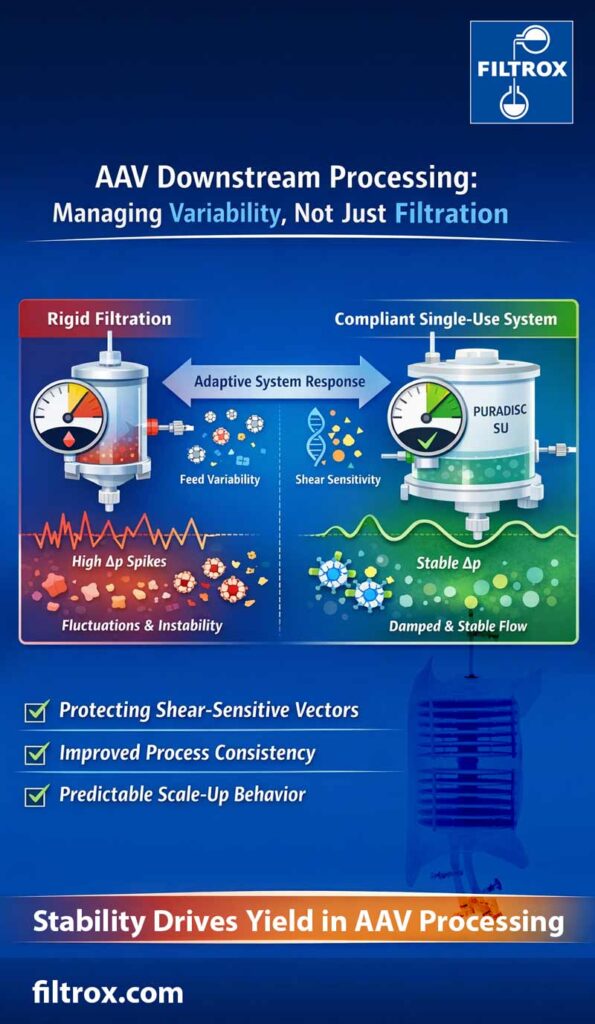
AAV downstream processing is not a filtration problem – it is a variability management problem.
Feed composition shifts, solids variability and shear sensitivity define process stability, not nominal filter ratings. In this context, filtration is no longer a passive unit operation. The filtration itself becomes part of the process dynamics.
Rigid filtration setups tend to transmit fluctuations directly : small changes in feed can result in immediate Δp (differential pressure) responses and unstable flow behavior. Δp is not just a pressure value – it is a real-time indicator of how the system responds to process variability.
More compliant system architectures behave differently: they damp pressure fluctuations, smooth the flow profile, and reduce the propagation of process noise. This is where system design becomes critical.
A compliant single-use setup like PURADISC SU introduces inherent hydraulic damping, stabilizing Δp progression and reducing system-induced variability in the process.
For AAV processes, this translates into:
- protection of shear-sensitive vectors
- improved process consistency
- more predictable scale-up behavior
In AAV, stability is not a luxury – it is a yield driver.
You don’t optimize AAV filtration by changing the filter – you optimize it by controlling the system response.



